

If you have completed a few semesters of college but couldn’t finish your degree due to a gap year, financial constraints, relocation, work pressure, or personal reasons, credit transfer can help you continue from where you left off.
Instead of starting all over again, credit transfer for degree completion allows eligible students to transfer earned academic credits from a previous institution and use them toward completing a new or continuing degree through a government-recognized university pathway.
This is one of the most practical solutions for:
- College dropouts who completed 1st/2nd year but didn’t finish
- Working professionals who paused studies due to job responsibilities
- Students who changed cities or colleges
- Learners who want to shift from regular mode to distance/ODL (where applicable)
Need guidance for your case? Explore degree completion pathways with Upgyan Academy.
What Does “Credit Transfer” Mean in Simple Words?
A credit is a measurable value given to a subject or semester (like marks, but in a structured academic format). Each completed subject/semester carries a number of credits.
Credit transfer means:
- The credits you already earned in your earlier college/university may be recognized
- Those credits may be mapped to your new program structure
- You can complete the remaining credits needed to finish the degree
So, instead of repeating the same subjects, you focus on what’s pending.
How Credit Transfer Works for Degree Completion (Step-by-Step)
While the exact process depends on the university and the program, the usual flow looks like this:
1) Academic Evaluation
Your previous academic records are checked:
- Previous university/college name
- Subjects completed
- Marksheets
- Credits/semester details
- Gap duration
- Eligibility rules
2) Credit Mapping
The university maps your earlier subjects to the current syllabus:
- Matching subjects may be approved for transfer
- Non-matching subjects may require additional papers/bridge subjects
3) Admission Into the Correct Entry Point
Based on transferred credits, you may be allowed into:
- 2nd year (lateral entry)
- 3rd year (if a larger portion is completed)
- Or a structured continuation route
4) Completion of Remaining Credits
You complete the remaining papers/credits through the approved mode (as per university norms), and then receive the final degree.
If you want a broader understanding of fast-track degree completion options, refer to this detailed resource:
Read the complete degree completion guide: https://upgyanacademy.com/complete-guide-graduation-in-one-year/
Who is Eligible for Credit Transfer?
Eligibility depends on university policies, but generally credit transfer is considered when:
- You previously studied in a recognized institution/university
- You can provide official marksheets / transcripts
- Your previous study duration, credits, and syllabus can be evaluated
- Your program is compatible with the new university’s structure
Most common eligible profiles:
- Completed FY/SY and left degree midway
- Diploma holders seeking progression (where applicable)
- Students who want course continuation due to relocation or life changes
Key Benefits of Credit Transfer for Degree Completion
1) Saves Time
You avoid repeating completed years/subjects, so your journey becomes faster and more efficient.
2) Saves Effort (and Motivation)
Restarting from first year is mentally exhausting. Credit transfer makes the process smoother and more realistic.
3) Helps Career Growth
Degree completion can support:
- Promotions
- Job eligibility criteria
- Better salary opportunities
- Higher education progression
4) Supports Learners With Gap Years
A gap doesn’t always mean the end of education. Credit transfer gives you a legitimate restart option.
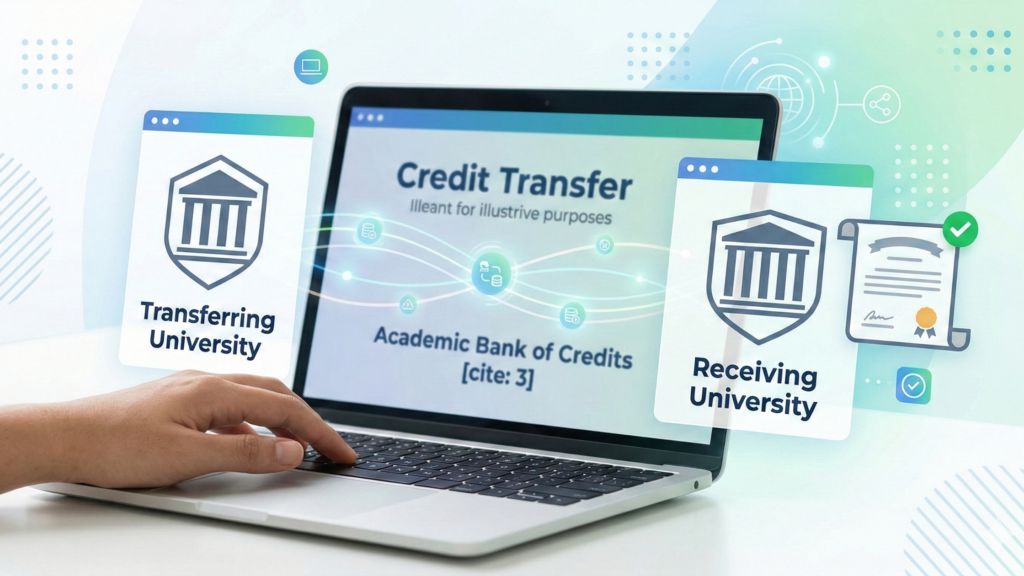
Credit Transfer vs Re-Admission: What’s the Difference?
Re-admission often means you rejoin the same course but may still need to repeat semesters depending on policy.
Credit transfer specifically focuses on:
- Recognizing your completed academic work
- Carrying credits to another recognized pathway (if allowed)
- Completing only the remaining part
What Documents Are Needed for Credit Transfer?
Prepare these in advance:
- All semester/year marksheets
- Leaving certificate / transfer certificate (if available)
- Aadhaar / ID proof
- Passport photo
- Any enrollment number / university details
- Migration certificate (if required)
Pro tip: If your marksheets don’t mention credits clearly, a transcript/statement of marks may be needed.
Common Mistakes Students Should Avoid
- Assuming every previous year is automatically accepted (it depends on mapping)
- Submitting incomplete marksheets
- Choosing the wrong program alignment
- Not checking recognition/validity before proceeding
- Delaying decisions and losing documents or academic continuity
How Upgyan Academy Helps With Credit Transfer Guidance in Mumbai
If you’re confused about:
- whether your previous college studies can be carried forward
- which program suits your current eligibility
- what entry point is possible
Upgyan Academy supports students with counselling and documentation guidance for credit transfer for degree completion, aligned to recognized university routes (as applicable to your case).
For working professionals planning higher studies, explore:
MBA course
For technical degree completion, explore:
Online BTech program
To verify approved distance/ODL recognition frameworks and institutional listings, refer to:
UGC Distance Education Bureau (DEB)
FAQs: Credit Transfer for Degree Completion
1) Is credit transfer valid in India?
Credit transfer is a recognized academic concept, but approval depends on university rules and documentation verification.
2) Can I transfer credits after a long gap?
In many cases yes, but it depends on:
- gap duration
- record availability
- syllabus compatibility
- university evaluation policies
3) Will I get direct entry to 2nd or 3rd year?
It depends on how many credits you have completed and what the university approves after mapping.
4) Do I need to repeat subjects?
Only if the university finds mismatches or you have incomplete credits for required subjects.
Conclusion

Credit transfer can be a practical solution for students and working professionals who have unfinished education and want to complete a recognized degree without repeating what they have already studied. By evaluating your past academic records, mapping your completed subjects to a current syllabus, and allowing entry at the appropriate level, credit transfer for degree completion helps you save time, reduce effort, and move forward with a structured plan.
If you are unsure about eligibility, document requirements, or which program aligns with your previous study, Upgyan Academy can guide you through the right university-approved pathway based on your profile.
Click Here to Get a Free Document Evaluation via WhatsApp
Address: Visit our Jogeshwari, Mumbai office for free career counselling.